

artEDition
Curated art, stories and writing
Dreaming the Acropolis: Freud, Imagination and the Future Image
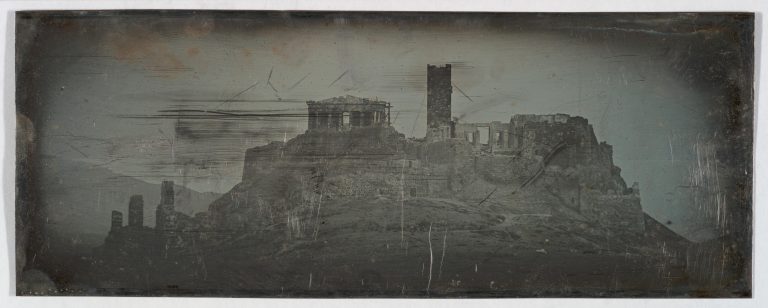
Western Approach to the Acropolis, Athens (49. Athènes. 1842. Acropole. Côté O.) by Joseph-Philibert Girault de Prangey (1804–1892), Daguerreotype, Image: 3 11/16 × 9 1/2 in. (9.3 × 24.1 cm), Metropolitan Museum of Art, Object Number: 2016.92, see https://www.metmuseum.org/art/collection/search/702991
In 1842, Joseph-Philibert Girault de Prangey — French photographer, draughtsman, and early pioneer of the daguerreotype (a photograph taken by an early photographic process employing an iodine-sensitized silvered plate and mercury vapour) — produced what is now considered the oldest surviving photograph of the Acropolis. The small, fragile plate, shimmering with unreacted silver halides, holds a faint yet persistent impression of the Parthenon. Made only three years after Daguerre announced his invention, it occupies a singular place in the history of photography and in the cultural imagination of antiquity. The daguerreotype — meticulous, fragile, unique — fixes the Acropolis in a trace of light drawn directly from stones already shaped by two millennia of weathering, destruction, and renewal. Seen today, the plate becomes a time-trap: each viewing returns us to the exact moment when light entered the camera.
De Prangey’s expedition was not merely documentary; it was an act of desire. The camera was new, and so was photography’s promise: an almost forensic fidelity that could secure the past for the future. His Acropolis image stages an encounter between two beginnings — the dawn of photographic vision and the enduring monument of classical antiquity. No longer mediated by drawing or description, the ruins are crystallised by light in a form at once optical, mechanical, and spectral. The early plate, singular and unrepeatable, becomes a one-to-one index of a moment. To view it today is to confront an uncanny doubling of memory: the ruin as record of history, and the photograph as record of that record. Hovering between clarity and opacity, reflective and evasive, it becomes a dream-image — an image of an image, a ruin of a ruin.
It is within this matrix of ruin and dream that Freud’s reflections on the Acropolis, written in 1936, gain new resonance. His disbelief when standing atop the citadel — “So all this really does exist!” — is less a travel anecdote than a meditation on the dreamlike quality of encountering ruins. Freud interprets his astonishment as a splitting of the self: one part marvels, another doubts. For him, the scene is structured like a dream: the impossible made real, the sense of being present and not present, awake yet dreaming. Dreams are condensations and displacements — fragments fused into scenes where memory, desire, and anxiety collide. The psyche, like the Acropolis, is layered: foundations, collapses, reconstructions, traces of forgotten rituals. To dream is to walk through these ruins and find that they still pulse with life.
Photography has always shared this affinity with dreams. For Barthes, the photograph is a “that-has-been,” a ghost of reality, a presence already past. To look is to be touched by absence. De Prangey’s daguerreotype embodies this paradox: it shows the ruin as it stood, yet what it shows is already gone — that precise day, that precise light. Photography rescues the past in flashes; for Derrida, it is a trace that both confirms and destabilises presence. Photographs function like dreams: they condense, displace, reveal in fragments. If Freud’s memory of the Acropolis is a disturbance of memory, so too is the daguerreotype: one psychic and internal, the other optical and external.
The ancients understood dreams as messages, warnings, templates for futures not yet realised. The Acropolis itself was such a dream-image: Athena’s vision for the city, Pericles’ projection of democratic splendour, a civic fantasy of endurance. Freud’s essay, written as Europe trembled under rising fascism, treats dreaming as a means of orientation amid instability — a way of salvaging fragments and imagining survival. The Acropolis speaks likewise: collapse is never final; fragments endure and become templates for futures yet unrealised and latent.
If dreams are psychic ruins and photographs are visual ones, both arise from residues — traces of light and memories. Both disturb and both condense time. De Prangey’s photograph becomes the visual analogue of Freud’s Acropolis: a surface that records, erases, and re-presents fragments of reality. Ruins are the dreams we inherit; dreams are the ruins we rebuild. To dream the Acropolis is to stand where Freud stood — astonished, unbelieving, yet compelled to accept that impossibility becomes real, that from fragments futures may still be imagined, and made visible in future photographs and possible in reality.
Michael Mersinis
2025
@michael_mersinis